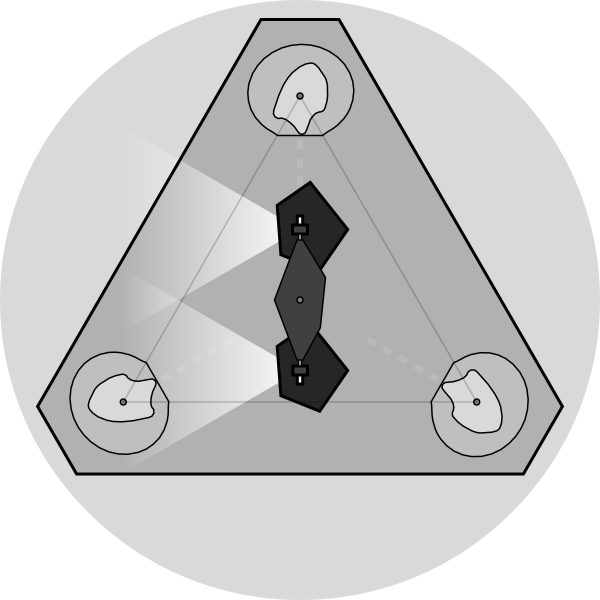
The sensor only "sees" inside the dashed circle — its sensitivity zone, like the photocell aperture on the physical female. Point a transmitter (a phone running /transmitter in flash mode) into the zone.
Sweep moves the zone side to side on a velocity-limited trapezoid profile — the same searching scan the simulated female performs with her body.
Brightness is the zone's average luminance (0–255). The background is a slow moving average that adapts to the room, so only changes stand out: delta = brightness − background. A flash spikes the delta; steady light melts into the background within seconds.
Whenever the delta exceeds the threshold, the sensor reads a 1; otherwise a 0. That single bit, sampled at a fixed rate, is all the mobiles ever exchange.
The last 40 bits are compared against the dictionary's six
light-channel search words using the simulation's own pattern matcher (compiled
from src/simulation/behavior/pattern-matcher.ts — the exact code the
simulated female runs). A word is decoded when at least 37 of 40 positions agree —
set the transmitter to the matching 20/40 Hz rate and hold it steady in the zone
for about two full cycles.